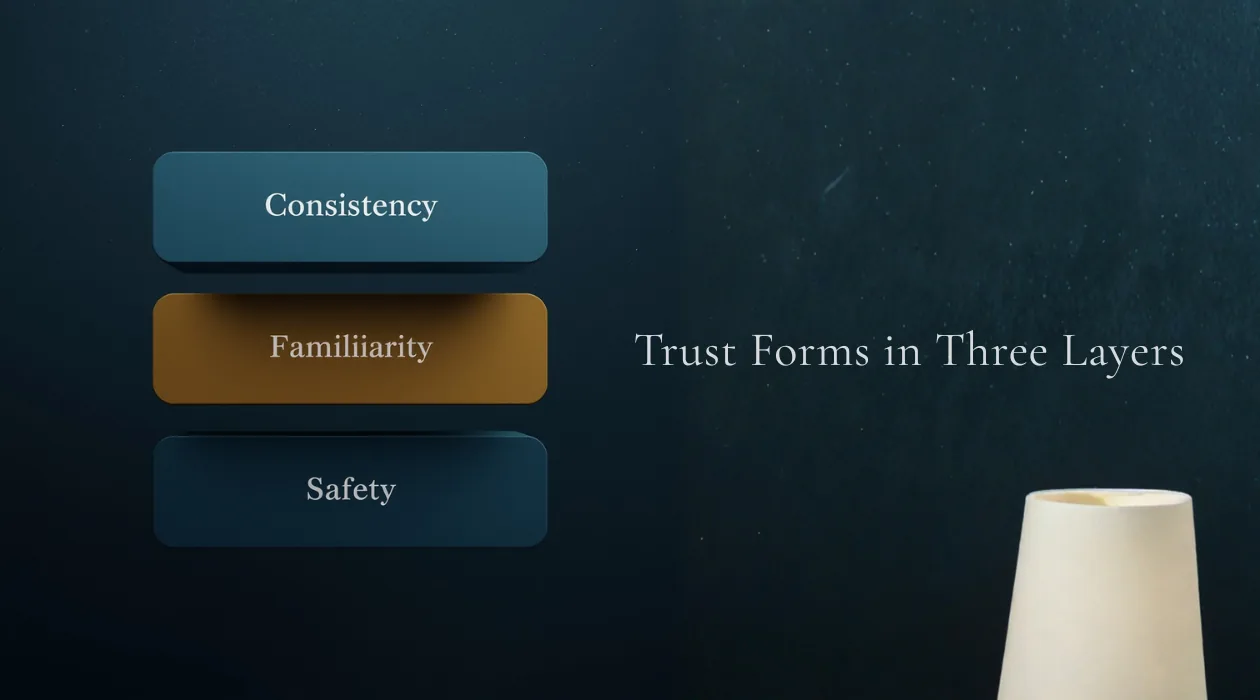
"Trust is not a logo. It is layers the brain checks in seconds, quietly, before you have said a word."
There is a moment most brands never consider. A person encounters your brand for the first time. Perhaps it is a LinkedIn post that appeared in their feed. Perhaps it is your website, found through a search. Perhaps it is your name, mentioned in conversation by someone they respect.
In that encounter, before a single conscious judgment is formed, something else is already happening. The brain is running a check. It is not reading your headline. It is not evaluating your credentials. It is doing something far older and far faster: scanning the signal for safety, searching for something familiar, and looking for evidence that you will behave the same way tomorrow as you did today.
This is not metaphor. This is the neuroscience of brand trust. And it operates in layers, each one building on the last, each one either opening or closing the door to everything that follows.
Brand trust, understood through the lens of neuroscience, is not a feeling you manufacture through clever messaging. It is a neurological architecture you either build with intention or leave to chance. The brands that endure, the ones people return to without being asked, are the ones that have built all three layers, in order, with patience.
Layer One: Safety, The Amygdala Votes Before Your Audience Does
The amygdala is the brain's oldest security system. Before the rational mind engages, before a person reads a headline or forms an opinion, the amygdala has already scanned the incoming signal and made its assessment. Safe or unsafe. Approach or retreat. Worth attention or not.
Research by neuroscientist Joseph LeDoux confirmed that the amygdala responds to emotional stimuli in approximately 12 milliseconds, far faster than conscious cognition. This means your brand's visual temperature, your tone of voice, and the presence or absence of pressure language are all processed as threat signals before a single word is read with intention.
When the amygdala registers safety, something remarkable follows. The prefrontal cortex, the seat of rational evaluation and trust, becomes available for engagement. Oxytocin, the bonding and trust hormone, begins to regulate the nervous system. Research published in the journal Neuron by Baumgartner and colleagues demonstrated that oxytocin not only increases trust but actively maintains it even after a trust breach, by reducing amygdala reactivity and fear-based feedback.
For brands, this means safety is not a design choice. It is a neurological precondition. A calm color palette signals safety. Unhurried typography signals safety. Language that offers rather than demands, that invites rather than pressures, that acknowledges the reader's autonomy rather than hijacking it, all of this signals safety. And a brand that fails this first check, through cluttered visuals, aggressive copy, or false urgency, does not simply lose a sale. It triggers a physiological retreat that no amount of clever messaging can reverse.
Neuroscience Note · Layer One
A 2026 neuromarketing study by Nielsen Consumer Neuroscience, using EEG and eye-tracking data from 3,200 participants across the US, UK, Germany, and Japan, found that initial brand impressions are fully formed within an average of 10.3 seconds. More significantly, 74.6% of participants showed measurable cognitive dissonance responses within the first five seconds of exposure to inconsistently applied brand visuals. The amygdala does not wait for context. It reads the signal immediately, and the emotional verdict it delivers shapes everything that follows.
Layer Two: Familiarity, The Brain Trusts What It Recognises
Once safety is established, the second layer begins its quiet work. Psychologist Robert Zajonc first documented what he called the mere exposure effect in 1968: people develop a preference for things simply through repeated exposure, even without conscious recognition of having encountered them before. The brain, having cleared a signal as safe, reduces its cognitive effort with each subsequent encounter. And reduced cognitive effort is interpreted, neurologically, as a positive feeling. As comfort. As trust.
This is not passive familiarity. It is an active neurological process. With each repeated encounter, the amygdala becomes measurably less reactive to the familiar stimulus. The prefrontal cortex signals acceptance more readily. What was once evaluated is now simply recognised. And recognition, at the neurological level, has the quality of warmth.
For brands, this is the mechanism behind the consistent visual motif, the signature phrase, the recognisable rhythm of content. These are not aesthetic preferences. They are hippocampal anchors: cues the brain encodes and retrieves automatically, creating the kind of pre-approved trust that no single campaign can manufacture.
"Familiarity is not repetition for its own sake. It is the patient training of the brain to recognise you, relax around you, and eventually seek you out without effort."
The cost of breaking familiarity is steep and often underestimated. In 2025, Cracker Barrel undertook a significant brand redesign, departing from the visual identity its audience had encoded over decades. The backlash was immediate and severe enough that the brand reversed course. What felt to the organisation like a creative evolution felt to the audience's nervous system like a violation of something deeply held. Because familiarity, once built, is not just preference. It is trust stored in memory. And disrupting it without care is a form of limbic rejection.
The lesson is not that brands should never evolve. It is that evolution must carry the signal of the familiar into the new, rather than replacing it entirely. The brain needs a thread it can follow.
Layer Three: Consistency, Behaviour Becomes the Memory
The third layer is where brand trust either completes its architecture or quietly collapses. Consistency, in the neurological sense, is not visual uniformity alone. It is the experience of a brand behaving the same way across every context, every channel, and every interaction over time. It is a brand that shows up when it says it will, responds the way its audience has come to expect, and maintains the same emotional signal whether it is communicating a new idea or handling a difficult moment.
The hippocampus encodes this behavioural pattern as memory. Each consistent experience adds another data point to the brain's internal record of who this brand is. Over time, that accumulated record becomes something far more powerful than awareness. It becomes what research by Lewicki and Brinsfield described as a decision heuristic: a cognitive shortcut that simplifies the information-processing task. In practice, this means the brain no longer needs to evaluate the brand. It simply trusts it.
The data reflects this in measurable terms. A 2026 McKinsey Brand Performance Index study, surveying 2,400 companies across North America and Europe, found that organisations maintaining consistent cross-channel messaging reported revenue increases averaging 33.7%. Research from Lucidpress confirmed that consistent color palette usage alone increases brand recognition by up to 80%. These are not decorative findings. They are the financial expression of neurological trust, accumulated through consistency over time.
It is worth distinguishing consistency from sameness. A brand that says the same thing repeatedly without depth is not building trust. It is building wallpaper. Consistency, properly understood, is the reliable expression of the same values, the same emotional register, and the same implicit promises, across diverse content, diverse channels, and diverse contexts. The words change. The voice does not. The format adapts. The signal stays true.
Research Anchor · Layer Three
The 2025 Edelman Trust Barometer Special Report, drawing on 34,000 respondents across 28 countries, found that 80% of people trust the brands they use personally, a figure that outpaces trust in government, media, and most institutions. This trust, however, is not granted freely. It is earned through consistent experience, verified over time. Practitioners in the same study described brand trust as "a building block and foundation for everything else," and emphasised that competency, predictability, and consistency are its three core dimensions.
Trust is not declared. It is demonstrated repeatedly, until the demonstration is no longer needed.
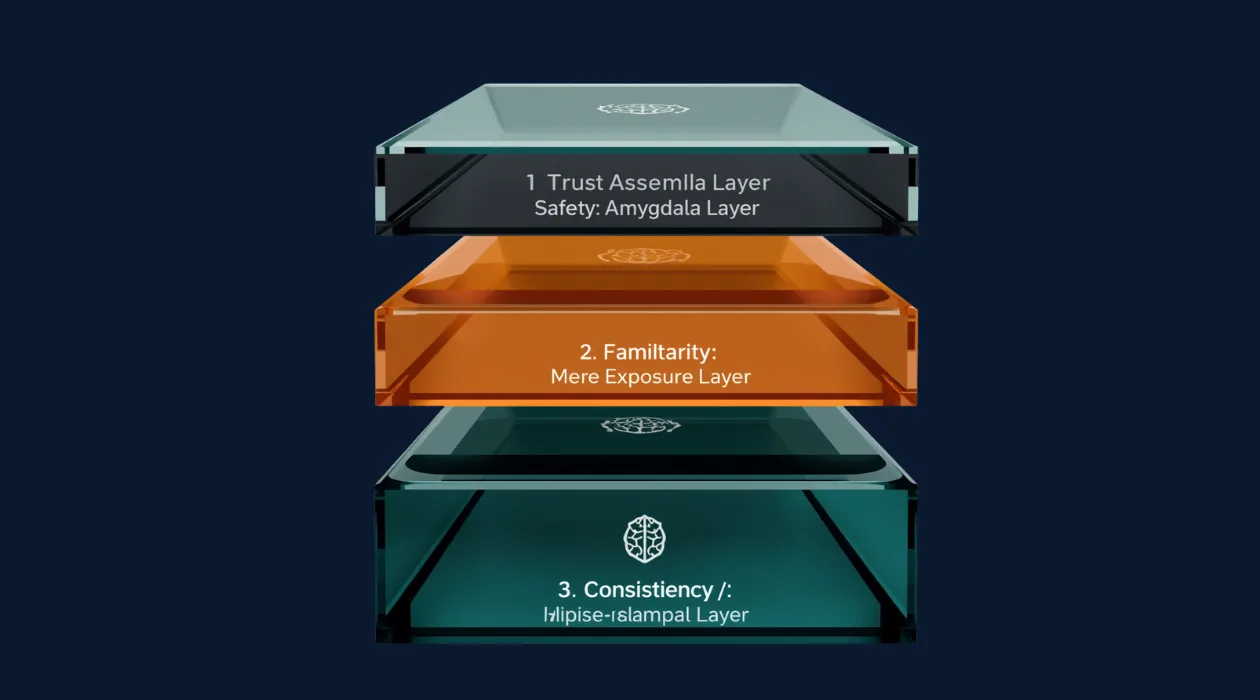
Mapping the Three Layers Across Your Brand
Understanding the three layers as a theory is one thing. Seeing them operating across your brand's actual touchpoints is where the work begins.
Every channel your brand occupies is primarily serving one of the three layers, though the most coherent brands serve all three simultaneously.
A website hero section is above all a Safety signal: the color temperature, the visual pace, the clarity of the opening statement either lower or raise the amygdala's threat response within seconds.
A LinkedIn content rhythm is primarily a Familiarity signal: a regular, recognisable publishing cadence is teaching the brain to expect and relax into the brand's presence.
A customer service interaction is the ultimate Consistency test: it is the moment where behaviour either confirms or quietly collapses everything the brand has communicated elsewhere.
The most common trust failure is not a single dramatic mistake. It is the quiet misalignment between layers. A brand that presents calmly, shows up regularly, and then responds to a difficult client moment with urgency or inconsistency has broken the third layer. And the brain, which was building trust patiently through layers one and two, registers this as a violation far deeper than a minor error. Because it now has evidence that the signal was incomplete.
A useful internal audit, take any brand touchpoint and ask three questions:
- Does it feel safe to engage with?
- Does it feel familiar, like something the brain has encountered before from this brand?
- Does it behave the same way as every other touchpoint from this brand?
If any answer is uncertain, that is where the architecture needs attention.
Reading the Signals Your Audience Is Already Sending
Trust leaves traces. Not always in the metrics most brands track, but in the behavioural signals that correspond directly to each of the three layers.
Saves and bookmarks are a Safety signal. When someone saves a piece of content, they are not simply expressing admiration. They are indicating that the brand felt safe enough, regulated enough, worth returning to. The nervous system did not retreat. It paused and filed the experience for later.
Return visitors and direct search are Familiarity signals. When someone types your brand name directly into a search bar, or returns to your content without being prompted by an algorithm, the mere exposure effect has done its work. The brain has encoded the brand and is now seeking it out. That is not awareness. That is memory forming into preference.
Long and thoughtful comments, unprompted referrals, and direct messages that begin with "I have been following your work for some time" are Consistency signals. They indicate that trust has compounded through time and repeated experience into something deeper than engagement.
The inverse signals are equally instructive. High reach with low saves suggests that the Safety layer may be incomplete. High saves with low return visits may indicate a Familiarity gap. The pattern always points somewhere useful.
The Architecture That Earns Trust Before You Ask For It
The brands that endure, the ones that accumulate genuine loyalty rather than manufactured attention, are rarely the loudest or the cleverest. They are the ones that understood, perhaps intuitively and perhaps through hard experience, that the brain does not grant trust all at once.
It tests for safety first. Then it looks for something familiar. Then it watches, patiently, to see whether the behaviour remains consistent enough to encode as memory.
This is not a framework for manipulation. It is a framework for integrity.
A brand that designs for Safety is a brand that respects the nervous system of its audience. A brand that builds Familiarity through deliberate, repeated signals is a brand that takes the long view. A brand that earns Consistency through behavioural alignment is a brand that has understood what trust actually is: not a feeling you create in a campaign, but a structure you build over time, quietly, from the inside out.
In the NeuroCulture Model™, this is what we call the Trust Nervous System. Not a metaphor, but a living architecture: a brand whose every signal, every rhythm, and every behaviour has been designed to regulate, to invite, and to endure.
Safety opens the door. Familiarity keeps it open. Consistency builds the home.
Trust is not announced. It is assembled, quietly, layer by layer, until the brain no longer needs to decide. It simply returns.
This article is followed by Why the Brain Remembers Stories, which explores the narrative architecture that deepens trust once the foundation is established. To map where your brand's trust architecture is complete and where it needs attention, the Neural Clarity Sprint™ is the diagnostic engagement built for exactly this.
Published by The LimbicForge Journal.
Take the next step
If this resonates, the Brand Nervous System Audit™ is a free 7-minute diagnostic that will show you exactly where your brand sits on the consent spectrum.
Begin the Audit